
About the author:
Sue, a graphic designer and web developer by profession, has never ventured into the realm of writing stories—until now. Traditionally, she spent her leisure time merging fine art textures with photography to craft dramatic still life and landscape images. However, as AI technology began to make its mark, Sue was drawn to explore MidJourney, an AI-driven platform.
Captivated by the evocative images produced by the AI, Sue felt that some of them were begging for narratives of their own. Motivated by this idea, she printed several images, choosing one that resonated with her the most as the starting point for her creative writing journey. The process was unexpectedly intuitive; the image seemed to guide her, almost scripting its own story. “Giggle” emerged as one of her first pieces, showcasing her newfound synergy with storytelling.
Flaws
© Susan Weller
All Rights Reserved
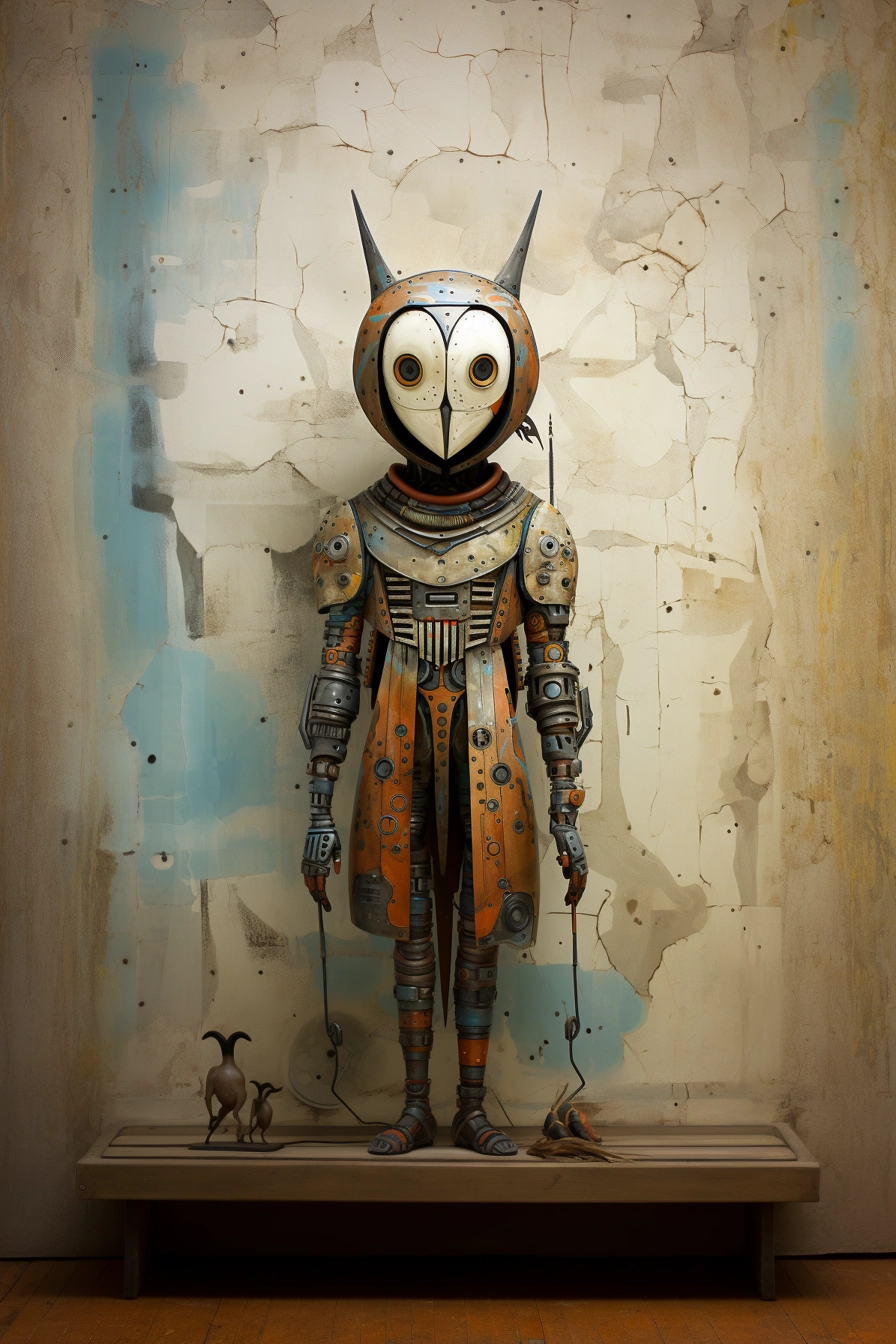
Sigh, I never liked that portrait. Not even sure why I had it made. Every time I pass by, I wonder: who is that? Then by the graces, I remember it’s me.
And it’s not like the portrait is inaccurate at all—it’s a full-body scan of me. It’s visually 100% accurate; from my blank expression to the patterns on my gear, it’s me.
Others have changed their scans, made subtle changes like eye color, or modified a pattern or two, or changed the small icons at their feet. They say they are correcting little flaws.
Others go all out and change almost everything—to the point that looking at them in person, then looking at the portrait, you think you are looking at two very different individuals indeed!
It’s not that I don’t believe I have flaws or that I would love others to think I looked “much better” while I was functional.
These portraits are displayed in one’s work environment while functioning; then, once decommissioned, your portrait is moved to the home ancestor gallery for display and remembrance.
And what does “much better” even mean?
There are no rules about the scan, you can do whatever you choose. Mine, sigh, I didn’t change. I mean, why should I?
I guess I had the scan created because I wanted to finally know what I looked like.
We generally only ever see our reflections, and those can be fractured and distorted based on where you happen to notice the reflection. There is no point in time that we truly encounter our full reflection so we only have a general idea of what we look like.
So I decided, for whatever reason I can’t honestly remember, I wanted to know what I looked like and try understand what the others were seeing. Thinking about it now, I more than likely wanted to know why people reacted to me the way they did. My mannerisms are the same as everyone’s. My responses to someone’s needs or requests are reprogrammed—so I guess I wanted to know why some individuals seem to look at me like something is out of place, or like I don’t look like I’m supposed to look! And for some reason I let these thoughts eat away at me, it was maddening!
So I ordered the scan, and to my surprise, I looked like everyone around me. Minor color shifts here and there, maybe some different appendages, but overall I look like everyone else.
So honestly, why is it, every time I pass my portrait I still wonder if that image is truly me?
About the author:
Sue, a graphic designer and web developer by profession, has never ventured into the realm of writing stories—until now. Traditionally, she spent her leisure time merging fine art textures with photography to craft dramatic still life and landscape images. However, as AI technology began to make its mark, Sue was drawn to explore MidJourney, an AI-driven platform.
Captivated by the evocative images produced by the AI, Sue felt that some of them were begging for narratives of their own. Motivated by this idea, she printed several images, choosing one that resonated with her the most as the starting point for her creative writing journey. The process was unexpectedly intuitive; the image seemed to guide her, almost scripting its own story. “Giggle” emerged as one of her first pieces, showcasing her newfound synergy with storytelling.
Flaws
© Susan Weller
All Rights Reserved